
The melting Greenland ice sheet is already a major contributor to rising sea level and if it was eventually lost entirely, the oceans would rise by six metres around the world, flooding many of the world’s largest cities. https://www.theguardian.com/environment/2016/sep/21/greenlands-huge-annual-ice-loss-is-even-worse-than-thought
Article courtesy of The Guardian by Damian Carrington
Monday, September 26, 2016

Thursday, September 8, 2016
Tackling food waste as a way to save the climate, too.
Recycling the staggering amount of food that's wasted into livestock feed is increasingly being seen as a tool in the U.S. effort against climate change. https://insideclimatenews.org/news/29082016/food-waste-global-problem-solutions-climate-change-recycling-landfills-greenhouse-gas-methane-global-warming
Article courtesy of Inside Climate News by Georgina Gustin
Article courtesy of Inside Climate News by Georgina Gustin
Soaring ocean temperature is 'greatest hidden challenge of our generation.'
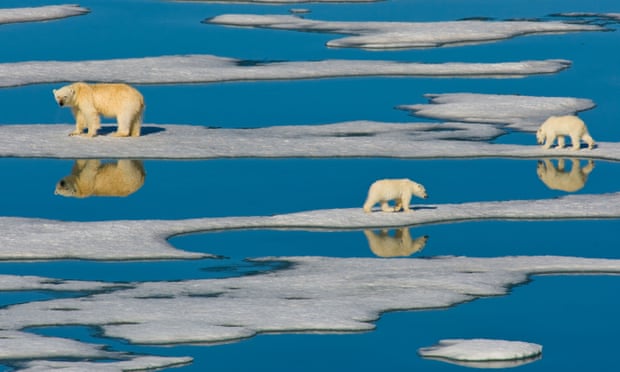
The oceans have already sucked up an enormous amount of heat due to escalating greenhouse gas emissions, affecting marine species from microbes to whales, according to an International Union for Conservation of Nature (IUCN) report involving the work of 80 scientists from a dozen countries.
https://www.theguardian.com/environment/2016/sep/05/soaring-ocean-temperature-is-greatest-hidden-challenge-of-our-generation
Article courtesy of The Guardian by Oliver Milman
Wednesday, August 24, 2016
Seals help show how melting ice shelves in East Antarctica affect deep ocean
Bottom water is formed when seas around Antarctica freeze over in winter causing salt to leach out of the sea ice. This process forms dense surface water that eventually sinks to form cold dense water that sits in the abyssal zone 4,000 metres to 6,000 metres below the surface.
In the long term, changes to bottom water would not only affect the circulation of water around the globe but have an impact on sea life that relies on the dense water to provide nutrients and gasses such as oxygen. http://www.abc.net.au/news/2016-08-24/seals-reveal-how-antarctica's-ice-shelves-affect-deep-ocean/7773362
Article courtesy of ABC Science By Genelle Weule
In the long term, changes to bottom water would not only affect the circulation of water around the globe but have an impact on sea life that relies on the dense water to provide nutrients and gasses such as oxygen. http://www.abc.net.au/news/2016-08-24/seals-reveal-how-antarctica's-ice-shelves-affect-deep-ocean/7773362
Article courtesy of ABC Science By Genelle Weule
Thursday, August 11, 2016
Chefs get creative about restaurant food waste.
The numbers are big. $218 billion of food is wasted every year in the United States—1.3 percent of national GDP, or $1,500 a year for a family of four. In a country with 48 million food-insecure people, this represents 1,250 calories per person, every day.
For restaurants and chefs, reducing food waste is becoming business as usual. Not only does it help the bottom line – a potential savings of $1.6 billion a year in an industry with tight margins—it saves resources all along the food supply chain. http://www.environmentalhealthnews.org/ehs/news/2016/aug/chef-food-waste
Article courtesy of Environment Health New by Kara West
For restaurants and chefs, reducing food waste is becoming business as usual. Not only does it help the bottom line – a potential savings of $1.6 billion a year in an industry with tight margins—it saves resources all along the food supply chain. http://www.environmentalhealthnews.org/ehs/news/2016/aug/chef-food-waste
Article courtesy of Environment Health New by Kara West
Scotland just produced enough wind energy to power it for an entire day.
For the first time on record, wind turbines have generated more electricity than was used in the whole of Scotland on a single day.
An analysis by conservation group WWF Scotland found unseasonably stormy weather saw turbines create about 106 per cent of the total amount of electricity used by every home and business in the country on 7 August. http://www.independent.co.uk/environment/scotland-wind-energy-renewable-power-electricity-wwf-scotland-a7183006.html
Article courtesy of The Independent by Ian Johnston
An analysis by conservation group WWF Scotland found unseasonably stormy weather saw turbines create about 106 per cent of the total amount of electricity used by every home and business in the country on 7 August. http://www.independent.co.uk/environment/scotland-wind-energy-renewable-power-electricity-wwf-scotland-a7183006.html
Article courtesy of The Independent by Ian Johnston
Dairy groups blast methane reductions: ‘Cows expel gas so they don’t explode’
California’s attempt to curb emissions of methane, a powerful greenhouse gas, is facing vocal opposition from a dairy industry that fears government meddling in the flatulence of its cows.
The California Air Resources Board (ARB) has set a goal of slashing methane emissions by 40% by 2030, from 2013 levels, and has targeted the belching and farting – known as “enteric fermentation” – of California’s 5.5 million beef and dairy cows, as well as the manure they create. https://www.theguardian.com/environment/2016/aug/10/cow-methane-reduction-california-dairy-industry
Article courtesy of The Guardian by Oliver Milman
The California Air Resources Board (ARB) has set a goal of slashing methane emissions by 40% by 2030, from 2013 levels, and has targeted the belching and farting – known as “enteric fermentation” – of California’s 5.5 million beef and dairy cows, as well as the manure they create. https://www.theguardian.com/environment/2016/aug/10/cow-methane-reduction-california-dairy-industry
Article courtesy of The Guardian by Oliver Milman
Subscribe to:
Posts (Atom)

 Posts
Posts


